
Background
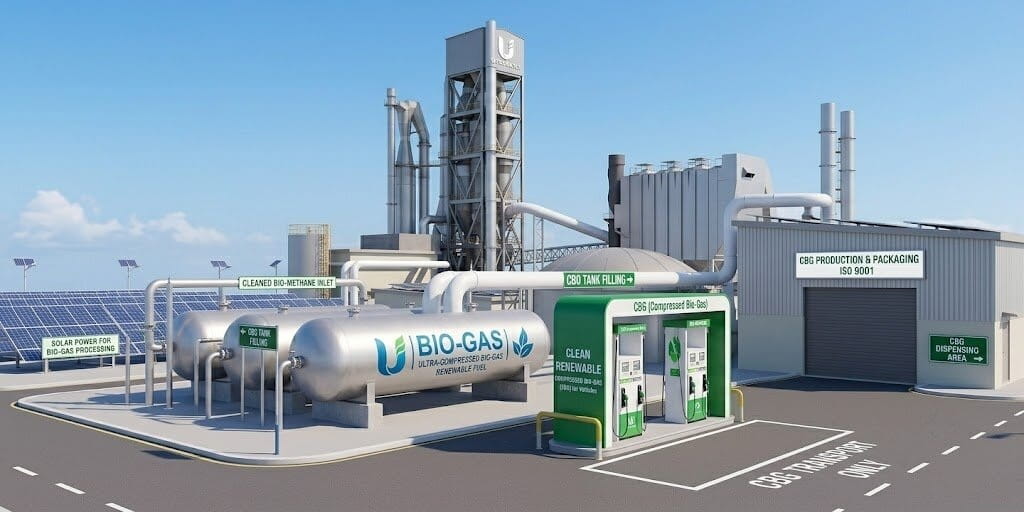
Biogas is produced from waste / bio-mass sources (e.g., agricultural residue, cattle dung, sugarcane press mud, municipal solid waste, and sewage treatment plant waste) through the process of anaerobic decomposition. Compressed Biogas (CBG) has calorific value and other properties similar to Compressed Natural Gas (CNG) and hence can be utilized as a green renewable automotive fuel. Thus, it can replace CNG in automotive, industrial, and commercial areas, given the abundance of biomass availability within the country.
The 'SATAT' (Sustainable Alternative Towards Affordable Transportation) Scheme on Compressed Biogas (CBG) was launched on 1st October 2018 by the Ministry of Petroleum and Natural Gas, Government of India. The objectives of the scheme are:
- Utilizing more than 62 MMT of waste generated every year in India
- Cutting down import dependence
- Supplementing job creation in the country
- Reducing vehicular emissions and pollution from burning of agricultural / organic waste
As per the Ministry of Petroleum and Natural Gas, it is planned to roll out 5,000 CBG plants across India in a phased manner. These plants are expected to produce 15 million tonnes of CBG per annum, which is about 40% of current CNG consumption of 44 million tonnes per annum. RBI has also notified that loans to start-ups (up to ?50 crore) for setting up CBG plants are included under priority sector lending.
Business Model
The business model has been framed by the Oil Marketing Companies and indicated in the Letter of Intents (LoI) issued to the entrepreneurs. CBG plants are proposed to be set up mainly through independent entrepreneurs who will be responsible for planning and execution of the projects (including sourcing of raw materials, operation, and maintenance of plants) as well as maintaining final product output quantity and quality.
CBG produced at these plants will be transported by the LoI holders through cascades of cylinders or pipeline to the fuel station networks of OMCs for marketing as a green transport fuel alternative. The 1,500+ CNG stations network in the country currently serves about 32 lakh gas-based vehicles which can be used for the purpose.
Loan Scheme — Compressed Biogas (CBG) under SATAT
| 1 | Sector | Waste to Energy / Bioenergy |
|---|---|---|
| 2 | Sub Sector | CBG under SATAT |
| 3 | Eligibility |
|
| 4 | Minimum Loan Amount | As per IREDA Norms |
| 5 | Loan Tenure | Up to 10 years excluding moratorium and construction period, or 80% of the life of contract agreement for sale of CBG, whichever is less |
| 6 | Moratorium | Up to 1 Year |
| 7 | Construction Period | Up to 1.5 Years |
| 8 | Debt Equity Ratio | 70:30 |
| 9 | IREDA Loan Limit | Maximum up to 70% of the project cost |
| 10 | Interest Rate | As per IREDA Policy |
| 11 | Upfront Equity | At least 50% of the Promoters' contribution should be brought in upfront in the form of pure equity |
| 12 | Primary Security |
|
| 13 | Collateral Security |
|
| 14 | General Conditions |
|
| 15 | All Other Terms & Conditions | As per IREDA guidelines |
Fees and Charges
As per existing guidelines of IREDA.
General Conditions
- The borrower shall provide all information and documents reasonably required in connection with the procurement of any goods, services and works to be financed by IREDA, as per the established commercial practices.
- IREDA may share the charge of assets as per extant policy.
- The subsidy / grant, if any given by the Central Government / State Governments shall be adjusted against loan sanctioned by IREDA.
- The interest subvention / interest subsidy, if any given by State / Central Govt., will be passed on to the project.
- Revenue from by-products such as Manure etc. may also be considered as part of the cash flow calculations during appraisals. However, annual and average DSCR of at least 1.0 and 1.10 respectively, be maintained for loan tenure without considering revenue from uncontracted by-products.
- Other terms and conditions shall be as per prevailing Financing Norms / Guidelines of IREDA.
Other Conditions
- Securities and terms & conditions of the loan may be aligned with Lead Lender / Lead Arranger, if any, to the satisfaction of IREDA.
- CMD, IREDA is authorized to make amendments / modifications / consequential changes, if any as may be required from time to time.